UNDERSTAND YOUR BRAIN ⚡

BRAINANATOMY

what's actually going on in there?

Your brain is the control centre of your body, helping you think, feel, move, learn, remember and respond to the world around you.

The brain is split into 3 main parts
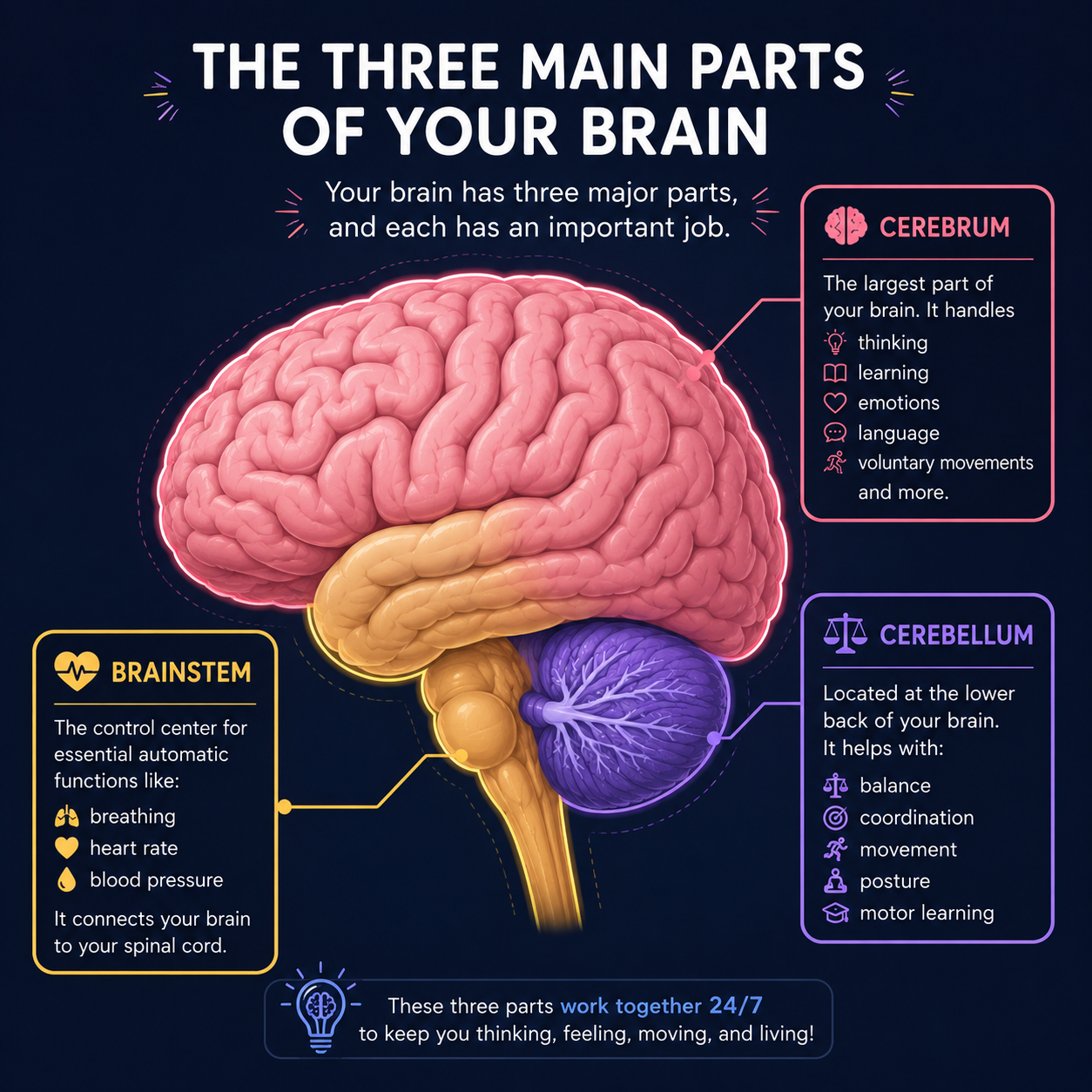
Diagram showing the three main parts of the brain: cerebrum, cerebellum and brainstem
Click a structure to explore →
🧠
Cerebrum
The biggest part of your brain
Thinking · emotions · senses · movement · learning. The cerebrum handles almost all of the brain's conscious abilities.
⚖️
Cerebellum
Coordination control centre
Balance · coordination · movement. Located at the lower back of your brain.
💓
Brainstem
Keeping you alive 24/7
Breathing · heart rate · sleep · other vital functions. It connects your brain to your spinal cord.
🧠
Cerebrum
Thinking · emotions · senses · movement · learning
⚖️
Cerebellum
Balance · coordination · movement
💓
Brainstem
Breathing · heart rate · sleep · other vital functions
Cerebrum

The biggest part of your brain

83%
The cerebrum makes up around 83% of the brain's weight and handles almost all of the brain's conscious abilities.
👁️
Five Senses
Helps process information from what you see, hear, smell, taste and feel.
💬
Language
Helps you understand and produce language.
🧠
Working Memory
Helps you temporarily hold and work with information.
🧍
Behaviour & Personality
Contributes to how you behave and respond.
🏃
Movement
Controls voluntary movements.
💡
Learning, Logic & Reasoning
Helps you learn, think, reason and solve problems.

But the cerebrum isn't just one giant piece of tissue.

The Cerebral Cortex

The cerebral cortex is the outermost layer of the cerebrum. It has a wrinkled surface that increases the brain's surface area and is made up of gray matter.

Your cerebral cortex handles high-level functions including:

🧠 Thinking 💬 Language 🏃 Voluntary Movement 👁️ Sensory Processing

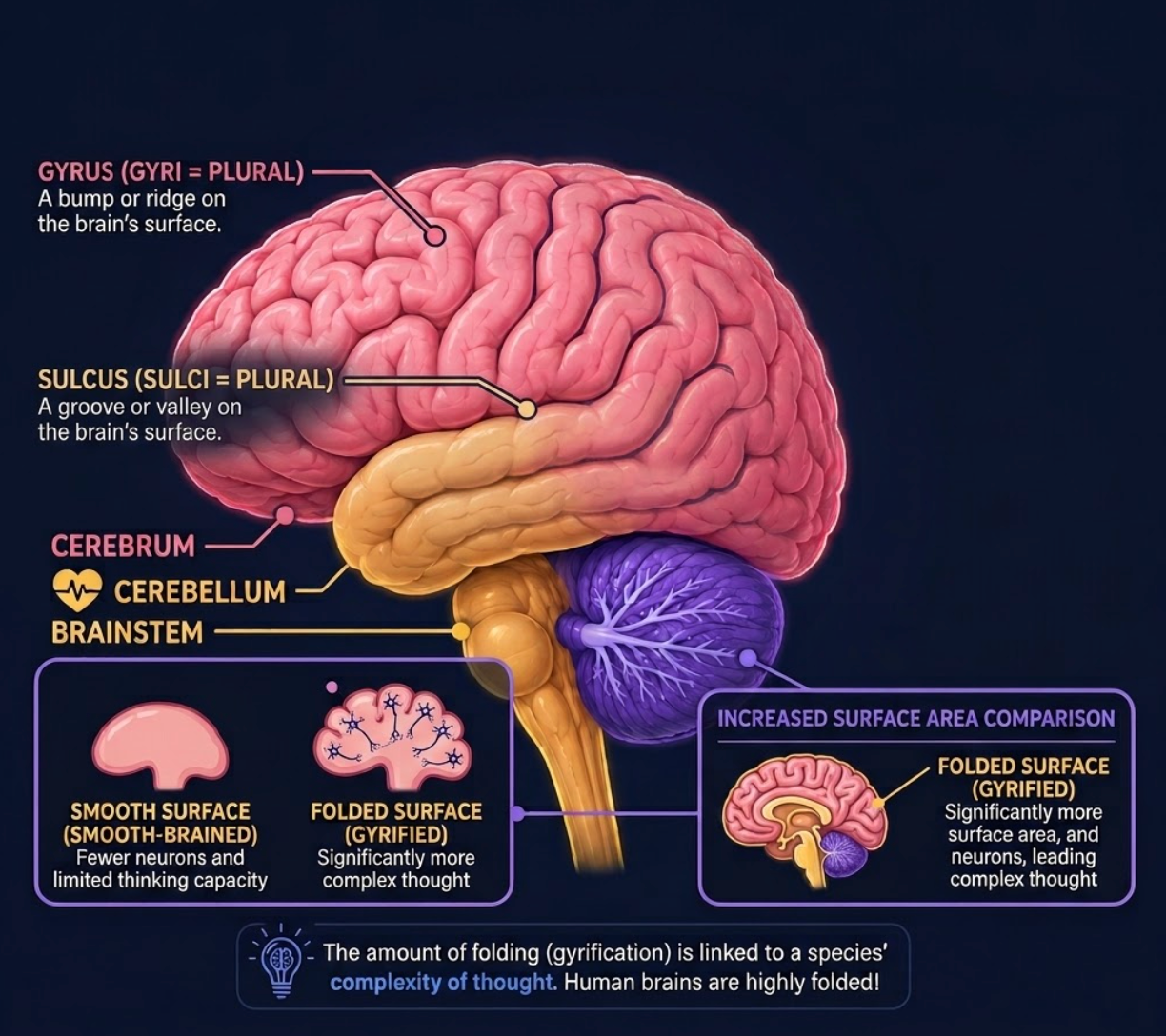
But why is the brain so wrinkly?

The folds increase surface area, allowing more neurons to fit into limited space.

Diagram showing gyri, sulci and fissures on the brain's surface
GYRI
Raised folds on the brain's surface
SULCI
Grooves between the folds
FISSURES
Deeper grooves in the brain

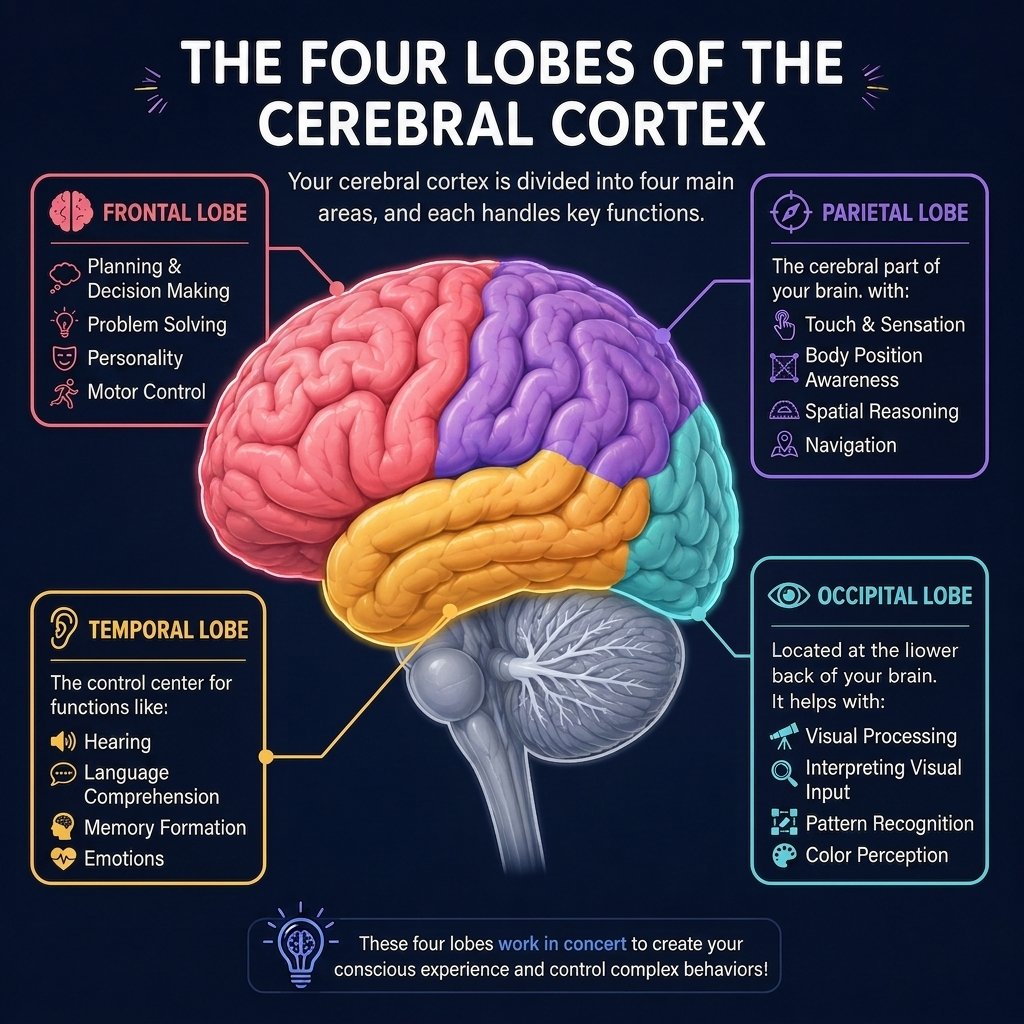
Your cerebrum has four major lobes

Diagram showing the four lobes of the cerebral cortex
Click a lobe to explore →
🟣
Frontal Lobe
The decision maker
Planning · reasoning · problem solving · emotional regulation. This is also where the prefrontal cortex lives.
🔵
Parietal Lobe
Sensory processing hub
Touch · body awareness · processing sensory information from around your body.
🟢
Occipital Lobe
Your visual centre
Vision. Located at the back of your brain, it processes everything you see.
🟠
Temporal Lobe
Sound, memory & language
Hearing · memory · language. Essential for understanding speech and forming memories.
Frontal Lobe
Planning · reasoning · problem solving · emotional regulation
Parietal Lobe
Touch · body awareness · processing sensory information
Occipital Lobe
Vision
Temporal Lobe
Hearing · memory · language

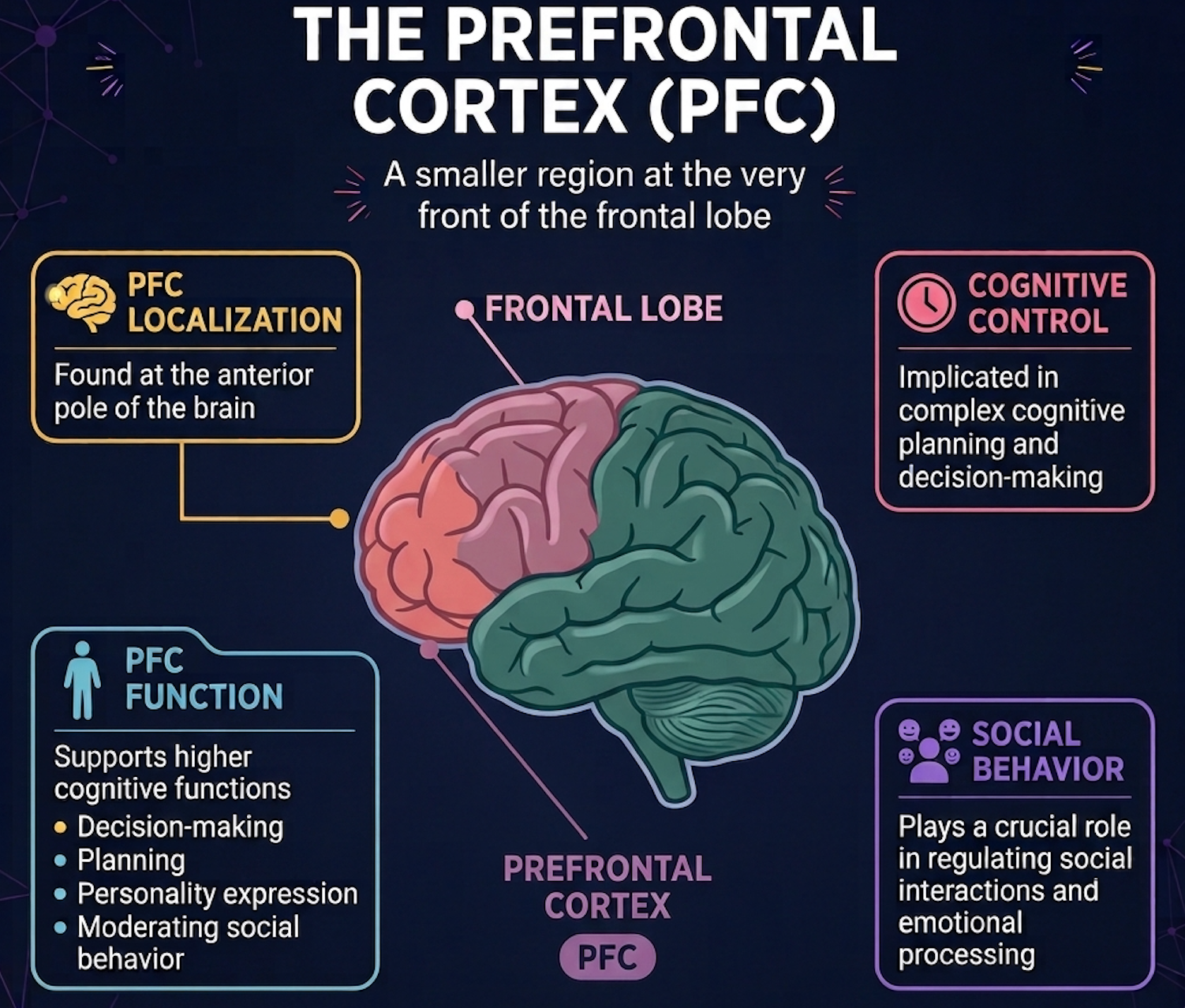
Meet the Prefrontal Cortex

The prefrontal cortex (PFC) is a region at the front of the brain involved in things like planning, attention, decision-making, working memory and emotional regulation.

Diagram highlighting the prefrontal cortex at the front of the frontal lobe

🧠 What's underneath? — Meet the limbic system

We've looked at the outside of the brain, but some of the brain's most important structures are tucked deeper inside.

HYP HYPOTHALAMUS AMY AMYGDALA HPC HIPPOCAMPUS INTERNAL STRUCTURES
Click a structure to explore →
🚨
Amygdala
Your brain's alarm system
Helps process emotionally significant information, detect possible threats, and is involved in learning and motivation. The amygdala plays a central role in emotional responses — which is why it's especially relevant when we explore emotions later.
🧠
Hippocampus
Memory & context
Helps form and organize memories, supports learning, and helps connect current experiences with past experiences.
⚙️
Hypothalamus
Brain ↔ Body
Helps connect the nervous and hormonal systems and helps regulate the body's internal balance.

🧠 Your teenage brain is still developing

During adolescence, your brain goes through major changes as it continues to develop and reorganize. This is partly because of processes such as neuroplasticity, synaptic pruning and myelination.

🏗️
Neuroplasticity
Your brain can change and reorganize.
Neuroplasticity is the brain's ability to adapt by forming, strengthening or reorganizing neural connections in response to experiences and learning.
Teen connection
What you repeatedly do gives your brain opportunities to adapt.
✂️
Synaptic Pruning
Your brain becomes more efficient.
During development, the brain reduces the number of synaptic connections that are used less frequently, while keeping and strengthening the ones that are used more often.
Teen connection
It's a bit like clearing out connections that aren't being used as much.
Myelination
Brain signals can become faster and more efficient.
Myelination involves the formation of a fatty insulating layer called myelin around axons, helping electrical signals travel more efficiently.
Teen connection
As your brain develops, communication between different brain regions becomes more efficient.

During adolescence, the brain is particularly adaptable. The experiences, learning and habits you have can interact with this ongoing development.

Your brain is constantly responding to what you do, experience and learn.

💚
Your brain isn't "broken" or incomplete. It's actively developing, reorganizing and becoming more efficient.

Your developing brain

🧠
BUILD
New connections can form through learning and experience.
✂️
REFINE
Some connections are reduced as the brain develops.
STRENGTHEN
Myelination helps signals travel more efficiently.
And that's one reason your teenage years are such an important period for brain development.

Your experiences and habits can interact with your developing brain.

Next up: discover the chemical messengers shaping your mood, motivation and behaviour.

BRAIN CHEMISTRY →