🧠
Prisha Pandey
📱 TECHNOLOGY

WHY IS YOURPHONE SO HARDTO PUT DOWN?

it's not just willpower

Modern technology can influence how your brain responds to rewards, attention, emotions and even sleep. But technology isn't automatically harmful — how you use it matters.

FIND OUT WHY →
📱
🔔
❤️
💬
🔄
👁️
🧠
THEN vs NOW

TECHNOLOGY HAS CHANGED

So has the way information reaches your brain.

THEN
📖 📻 📺

Books, radio, early television. These were more linear. You read a book page by page. You listened to a radio show from start to finish. The brain had time to process, reflect, and form deeper neural connections around the content.

NOW
📱 📲 💻

Modern smartphones and social media are fundamentally different. They're designed to capture and hold your attention using techniques that work with (and sometimes against) your brain's own reward systems.

01
Algorithmically curated
A machine learns what keeps you watching.
Algorithms analyse your behaviour — what you click, how long you pause, what you skip — and feed you more of exactly what keeps you engaged. The content isn't random; it's selected specifically for your brain.
02
Variable-ratio reinforcement
You never know when the next reward will appear.
You never know when the next "reward" — a funny video, a like, or a message — will appear, so you keep scrolling. This unpredictability is the same mechanism that makes slot machines compelling. Your brain keeps seeking because the next reward could be right around the corner.
03
Always available
Infinite content, zero signal to stop.
A smartphone in your pocket at 2am has infinite content. Unlike a book with a last page or a TV show with an end, the feed never runs out. The brain never gets a natural signal to stop.
THE SCROLL LOOP

WHY CAN'T I JUST
STOP SCROLLING?

It's a loop — and your brain's reward system is at the centre of it. Click each stage to explore.
🥱
Trigger
Boredom, anxiety, notification
💭
Urge
"I'll just check my phone."
📱
Behaviour
Open app / scroll feed
🎁
Reward
Funny video, like, message
🧪
Dopamine
Brain's reward chemical fires
🔄
Want more
Check again → Repeat
The brain doesn't know what the next scroll will bring. And that's part of what keeps you checking.
Trigger
The loop usually starts with a feeling — boredom, a moment of anxiety, or an actual notification ping. Your brain is looking for something to change the emotional state, and your phone is the quickest, easiest source of stimulation available.
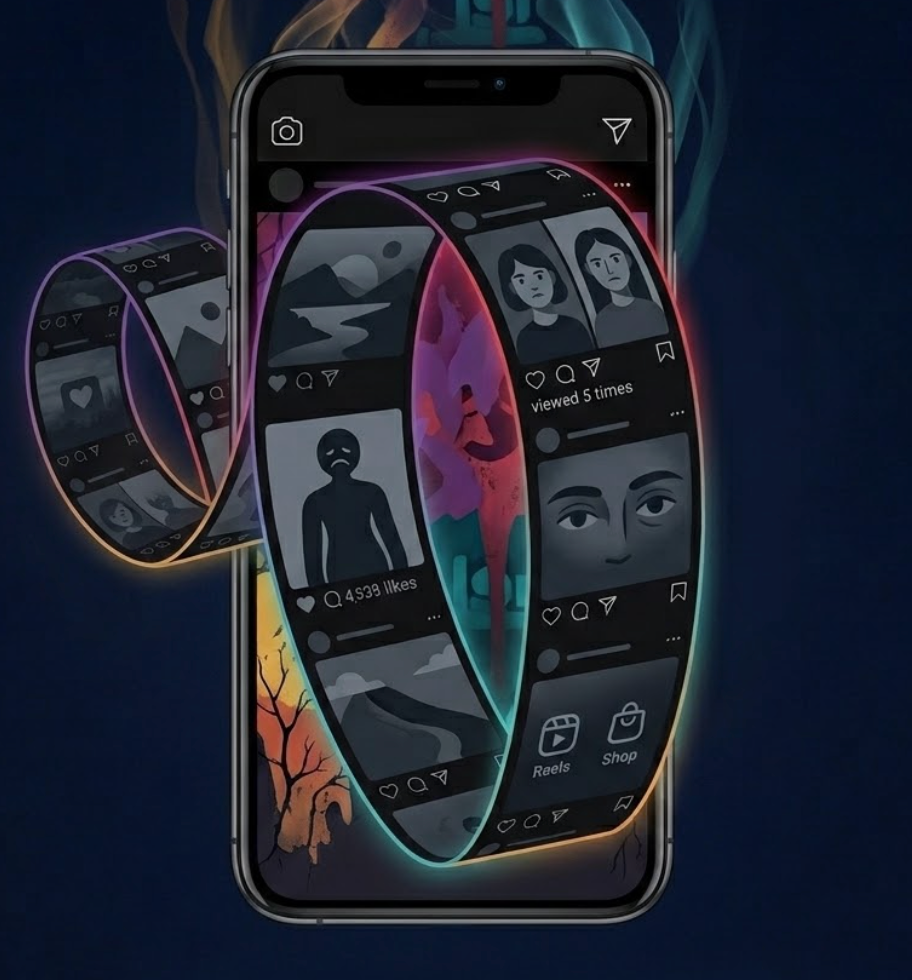
Scrolling loop illustration showing a phone with an infinite feed spiralling outward
REWARD PREDICTION ERROR

THE "WHAT WILL I GET?" EFFECT

You don't know what's coming next. Every swipe could produce something expected — or unexpectedly rewarding.

📱
Tap to swipe
🧠 Reward prediction error
Your dopamine neurons respond to the difference between what you expected and what you actually got. An unexpectedly good notification can produce a large dopamine response, while an unrewarding outcome can also motivate another attempt — because the next one might be different.
YOUR DEVELOPING BRAIN

WHY DOES THIS MATTER
DURING YOUR TEEN YEARS?

The teenage brain has extraordinarily high neuroplasticity — the ability to reorganize itself by forming new neural connections. That makes this period both powerful and sensitive.

🏎️
ACCELERATOR
Limbic system
Your brain's reward and emotion centre. Fully active during the teen years and highly responsive to novelty, social feedback and pleasure.
VS
🛑
BRAKES
Prefrontal cortex
Responsible for impulse control, planning, and evaluating consequences. Still maturing — it won't be fully developed until your mid-twenties.
This isn't a character flaw — it's neurodevelopmental biology.
NEUROPLASTICITY

YOUR BRAIN ADAPTS
TO WHAT YOU DO

Whatever a teenager spends time doing, the brain is literally building itself around those activities. The pathways you use get strengthened and insulated. The ones you don't get pruned away.

📱
Rapid scrolling
⚡ Rapid stimulation
🔄 Repeated reward seeking
🧠 Those pathways get used more
📚
Sustained focus
🎯 Practice and attention
🔁 Repeated deep engagement
🧠 Attention pathways strengthen
Repeated experiences can influence which neural pathways are strengthened and which are used less. This doesn't mean a single behaviour causes permanent changes — the brain remains adaptable.
THE BIGGER PICTURE

TECHNOLOGY ISN'T
THE VILLAIN

It would be intellectually dishonest to pretend modern technology is purely harmful. Here's what it can do well.

🎓
Education
University lectures, coding tutorials, research papers — accessible to anyone with a connection.
🧠
Learning
Language-learning apps using spaced repetition, a technique that works with your brain's memory consolidation process.
👥
Collaboration
Working together in real time across distances — documents, code, creative projects.
🔬
Visualisation
3D models, interactive anatomy tools, simulations — making complex concepts tangible and explorable.

THE KEY DISTINCTION

🟢 ACTIVE USE
  • Creating
  • Solving
  • Researching
  • Communicating with purpose
Engages the prefrontal cortex (PFC) — your brain's planning and reasoning centre
🔴 PASSIVE CONSUMPTION
  • Mindless scrolling
  • Constant stimulation
  • Algorithmically curated feeds
Different pattern of brain engagement — reward-driven rather than goal-directed
CONTEXT SWITCHING

WHY CAN'T I FOCUS
AFTER CHECKING MY PHONE?

Every time your brain switches from one task to another — textbook → notification → textbook — it has to re-establish what it was doing. Repeated rapid stimulation can train the brain toward a shallow, scanning mode optimised for processing lots of superficial information quickly rather than deep, sustained analytical thinking.

📚
Focus
🔔
Notification
📱
Phone
📚
Back to work
🧠
Re-establish focus
YOUR FEELINGS ONLINE

TECHNOLOGY AND
EMOTIONS

Technology doesn't just affect your attention — it interacts with your emotional brain too. Click each card to learn more.

❤️
Likes
Social approval
Receiving likes activates reward-related brain regions. Over time, some people begin to associate their self-worth with the number of likes they receive, which can create a dependency on external validation.
👥
Comparison
Curated vs real
You're comparing your everyday life — the unfiltered version — with other people's curated highlights. This comparison isn't balanced, and the brain doesn't always adjust for that difference.
😬
FOMO
Fear of missing out
Seeing others doing things without you can trigger anxiety and a sense of exclusion. FOMO is amplified by social media because you now have constant visibility into what everyone else is doing.
💬
Rejection
It can literally hurt
Online rejection can activate brain regions associated with physical pain. Being left on read, unfollowed, or excluded from group chats engages the same neural circuits involved in social pain processing.
IT DEPENDS

TECHNOLOGY:
TOOL OR TRAP?

Click each scenario to see how the same device can be used very differently.

Talking to a friend you couldn't otherwise reach
🟢 Connection — Maintaining relationships across distance is a genuine benefit. This is purposeful, active use.
Learning something new
🟢 Cognitive benefit — Actively engaging with educational content exercises attention, memory, and analytical thinking.
Scrolling because you're bored
🟠 Passive consumption — Not harmful in isolation, but when it becomes the default response to boredom, the brain misses out on other processes that boredom can activate.
Checking your phone every few minutes while studying
🔴 Context switching — Each switch forces the brain to re-establish focus. This pattern can reduce the quality and depth of learning.
It's not simply how much technology you use.
It's how, why and when you use it.
LIGHT → BRAIN → SLEEP

YOUR PHONE CAN
FOLLOW YOU INTO BED

There's a direct pathway from your phone screen to the part of your brain that controls when you fall asleep. Click through each step to follow the signal.

📱
Screen
👁️
Retina
🧠
SCN
🌙
Melatonin
😴
Sleep delayed
Your phone screen emits blue-wavelength light — even in "night mode," some of this light reaches your eyes. Tap each step to follow how this signal travels through your brain.
Want the full story? → Explore Sleep
RECOGNISE THE PATTERNS

WHAT COUNTS AS
"MISUSE"?

Using technology in ways that replace activities critical for brain development — including face-to-face social interaction, physical exercise, sleep, unstructured play and boredom. Click each pattern to see why it matters.

🔁
Compulsive use
Repeatedly checking your phone even when you don't want to — driven by habit loops rather than conscious choice.
📱
Extended passive scrolling
Long periods of mindless consumption can displace activities that exercise deeper cognitive processes.
📚
During focused homework
Using devices during work requiring sustained attention creates constant context switching, reducing learning depth.
☀️
Immediately upon waking
Starting the day with rapid stimulation can set your brain into a reactive, reward-seeking mode before it's fully transitioned from sleep.
🌙
In the hour before sleep
Both the light and the stimulation interfere with your brain's natural wind-down process, suppressing melatonin and delaying sleep onset.
🧍
Replacing in-person interaction
Face-to-face social interaction engages brain regions involved in empathy, reading body language, and emotional regulation in ways that screens cannot fully replicate.
POSITIVE NEUROPLASTICITY

THE HOPEFUL PART:
YOUR BRAIN CAN ADAPT

The same process that makes teens incredible learners also makes them incredibly vulnerable. Deliberately shifting behaviour toward activities requiring sustained attention gives the brain opportunities to adapt in that direction.

📱
Rapid
stimulation
↔️
📚
Reading
🎸
Music
🏸
Sport
💬
Conversation
🧠
Learning
Your brain is adaptable. It's not about repairing damage — it's about building in the direction you choose.
PRACTICAL STEPS

TAKE BACK
CONTROL

Small, realistic changes. Not "quit your phone" — just adjust the balance. Click each card for more.

🔕
Reduce interruptions
Turn off non-essential notifications. Each notification is a trigger that restarts the scrolling loop. Fewer triggers = fewer habit cycles.
📱
Add friction
Put your phone in another room while studying. The extra effort of walking to get it gives your prefrontal cortex a chance to override the impulse.
🧠
Train sustained attention
Start with short periods of focused reading without checking your phone and gradually extend them. Like any skill, sustained attention improves with practice.
💤
Allow boredom
Boredom activates the default mode network — a brain network associated with self-reflection, creativity, planning and memory consolidation. It's not wasted time.
🎨
Create, don't just consume
Writing, drawing, coding, making music — creating engages your prefrontal cortex and builds different neural pathways than passive consumption does.